
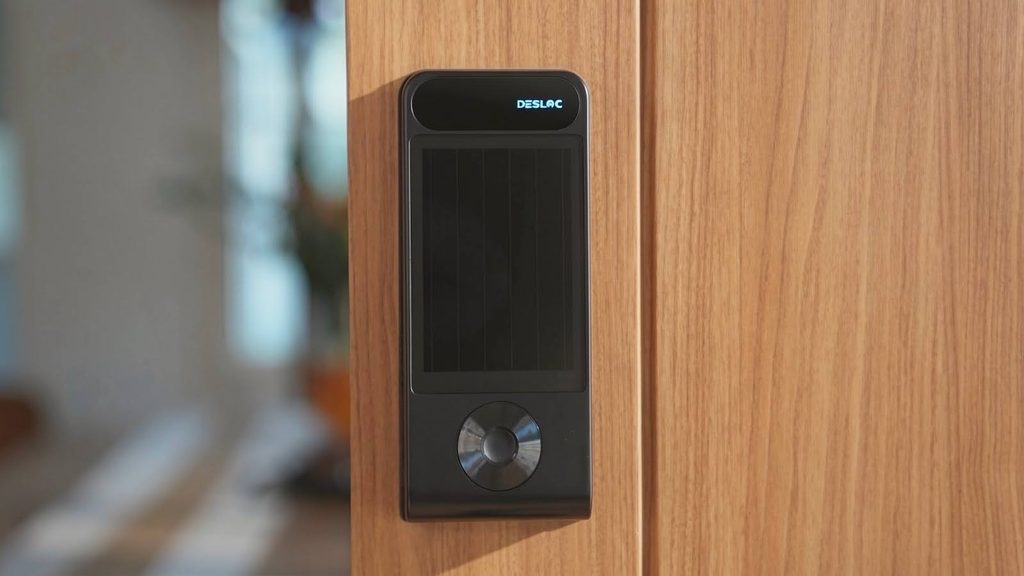
Smart locks solve one problem and create another. You stop fumbling for keys, and in exchange you take on a new chore: remembering to charge a battery bolted to your front door, usually right when you’re about to leave for a trip. The Desloc Smart Lock V150 Plus is built around the idea that this trade-off shouldn’t exist. It’s a Wi-Fi deadbolt with face and fingerprint recognition like a dozen other locks on the market, but it also carries a solar panel across its faceplate that keeps its 10,000mAh battery topped up using whatever light hits your door, direct sun or not.
We put it through the questions that matter for anyone considering a $260 lock for their front door: Does the solar charging actually work on a shaded porch or during a gray week? Is the face and fingerprint recognition fast and reliable enough to trust with the door you lock every night? And is any of this worth it over a lock that just takes AA batteries? Short version: the solar system genuinely reduces how often you think about battery level, the biometric unlocking is quick, and the lock is a strong pick for anyone who wants to stop swapping batteries — with a few caveats on installation and price.
Why you should trust this review
We evaluate smart locks with factors that actually matter: on whether the core promise holds up under normal, slightly inconvenient household conditions, not lab conditions. A solar-charging lock lives or dies on questions a spec sheet can’t answer — what happens to the battery on a north-facing door, in December, during a stretch of overcast days. So our focus was the lock’s power system and its biometric unlocking, the two features Desloc leads with, alongside the basics every deadbolt has to nail: does it lock reliably, does the app work without a fight, and is installation something a renter or a first-time DIYer can manage in an afternoon.
Desloc V150 Plus: At a glance
| Spec | Detail |
|---|---|
| Price | $229.99 at a discounted price (retail price $299.99) (Get $40 OFF + Extra $30 OFF with code: PRV150 until Oct 31, 2026) |
| Power | Built-in perovskite solar panel + 10,000mAh li-ion battery; USB-C emergency backup |
| Battery life | Up to 8 months on a full charge with no sunlight at all |
| Unlock methods | 3D infrared face recognition (50 faces), fingerprint (50 prints, 0.15-second read), app, physical key, voice (Alexa, Google Assistant) |
| Connectivity | Built-in 2.4GHz Wi-Fi (no hub required), Bluetooth |
| Security rating | BHMA Grade 3, IP65 weatherproofing, UL listed |
| Door fit | 1⅜–2″ thick doors, 2⅛” cross-bore, 2⅜” or 2¾” backset |
| Operating range | -22°F to 158°F |
| Warranty | 12 months, 30-day money-back guarantee |
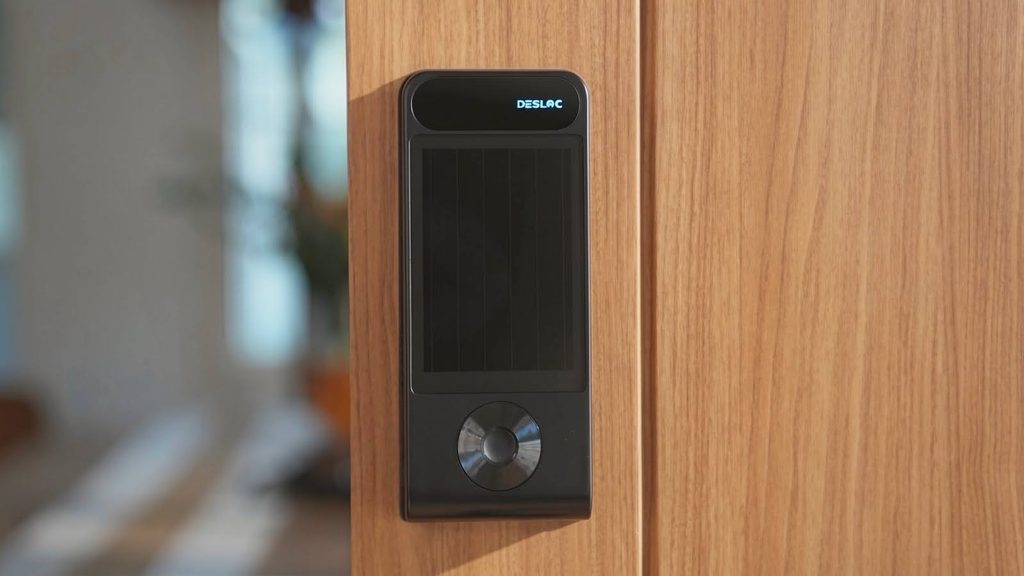
The headline spec is the one the name is built around: a solar panel embedded in the exterior faceplate, paired with what Desloc calls a BMS (battery management system) that reads ambient light and adjusts how the lock charges and discharges accordingly.
The solar panel is the whole point, and it mostly delivers
Most smart locks run on four AA batteries and nag you with a low-battery chirp every few months, usually at the worst possible time. Desloc’s answer is a perovskite solar cell built directly into the lock body. Perovskite is the detail worth knowing: unlike the silicon panels on solar chargers and garden lights, perovskite cells convert diffuse, low-intensity light — an overcast sky, a covered porch, the glow through a storm door — into usable power far more efficiently. That’s the difference between a solar gadget that only works in full sun and one that quietly tops up a battery all day, every day, regardless of weather.
Behind that panel sits a 10,000mAh lithium battery and a BMS, or battery management system, that Desloc built specifically for this use case. It’s constantly reading two things: ambient light levels and the lock’s own power draw, then deciding in real time how much to charge, how much to hold in reserve, and how to protect the battery from overvoltage on a bright day or inefficient trickle-charging on a dim one. In practice, this is what separates a lock that’s technically solar-powered from one that actually solves the problem: the BMS is doing the thinking so you don’t have to.
The number that matters most for a front door, though, is what happens with zero sunlight. Desloc rates the battery at up to eight months of runtime on a single charge with no solar input at all, which means even a lock mounted on a shaded, north-facing door in a dim hallway entry should comfortably outlast a full winter before you’d ever need to plug in the USB-C backup port. That reframes the solar panel less as a primary power source you’re relying on and more as a hedge — something that keeps quietly extending your runway in the background, so “is it charged” stops being a question you ask before a trip.
The app tells you what your lock is doing, not just whether it’s locked
Most lock apps show one piece of battery information: a percentage. Desloc’s app adds a dashboard built around the solar system specifically — current charge level, how much light the panel is pulling in, and a rough sense of charging efficiency over the past few days. It’s a small addition, but it’s the piece that makes the solar claim verifiable rather than a marketing line you have to take on faith. If the lock is sitting at 40% after a cloudy week, you can see that trend rather than getting blindsided by a dead battery.
The rest of the app covers what you’d expect from a mid-range smart lock: remote lock and unlock, an activity log of who came and went and when, a Vacation Mode that restricts guest access while you’re away, and management for multiple users’ faces, fingerprints, and codes. Face and fingerprint data are stored locally on the lock itself rather than in the cloud, and the system includes 3D liveness detection meant to stop someone from unlocking the door with a photo. Both recognition methods work without an internet connection, which matters more than it sounds like — a lock that stops functioning when your Wi-Fi does is a lock you can’t fully trust.
Installation and everyday use
At 7.17 inches tall on the exterior and 1.38 inches deep, the V150 Plus is noticeably chunkier than a standard deadbolt — the solar panel and biometric sensors have to live somewhere. It fits standard door prep (1⅜ to 2 inches thick, a 2⅛-inch cross-bore, either common backset size), so most doors that already have a deadbolt hole won’t need modification. The box includes both mounting plates, an adjustable deadbolt, a door sensor, two mechanical keys as a manual backup, and enough spare hardware that a missing screw won’t stall the job. Installation is the usual smart-lock routine — swap the existing deadbolt, wire the interior and exterior halves together, pair with the app — and is realistic to finish in under an hour without professional help, though anyone who’s never swapped a lock before should budget extra time for squaring up the strike plate.
Day to day, the fingerprint sensor is the unlock method we reached for most: Desloc claims a 0.15-second read, and it felt close to that in practice, quicker than typing a code and less finicky than lining up a face scan in low porch light. The auto-lock feature re-engages the deadbolt after the door closes, which matters more than it sounds like — it’s the difference between a smart lock that’s actually secure and one that’s only locked when you remember to lock it.
Flaws but not dealbreakers
The solar panel only helps if your door actually sees some light during the day. A deeply recessed entryway, a covered porch that blocks even diffuse light, or a north-facing door in a climate with long winters will lean much harder on the battery’s eight-month baseline than on the panel’s top-up. That baseline is generous enough to make this a non-issue for most homes, but it’s worth being honest that the solar feature is a bonus on a low-light door, not the primary power source Desloc’s marketing sometimes implies.
The lock is also larger and more expensive than a basic Wi-Fi deadbolt — at $259.99, it costs more than locks that skip biometrics and solar entirely, and its size may not suit every door’s aesthetic, particularly slimmer or more traditional doors. And while local biometric storage is reassuring from a privacy standpoint, anyone uneasy about face and fingerprint data living on a device bolted to their front door — even locally — should weigh that against the convenience before buying in.
How it stacks up against the competition
Lockly, the best-known name in fingerprint smart locks, is the natural comparison, and the two take different bets. Lockly’s locks are well-refined on fingerprint and keypad security but still run on standard replaceable batteries — you’re back to the same charging-anxiety problem the moment the battery gets low, just with a nicer app around it. Desloc’s pitch is narrower but more specific: it’s the only lock in this category building self-charging into the hardware itself, rather than treating power as an afterthought solved by bigger batteries or battery-life optimization alone. That’s a meaningful differentiator if the recurring hassle of smart-lock ownership, for you, is remembering to check and replace batteries — less so if you just want the single fastest, most polished fingerprint experience and don’t mind swapping batteries twice a year.
Who this lock is for
The V150 Plus makes the most sense for homeowners who’ve already been annoyed by a dead smart-lock battery at an inconvenient moment, and for anyone drawn to biometric unlocking who doesn’t want to think about maintenance at all. It’s also a reasonable pick for households managing several people’s access — kids, a dog walker, a cleaner on a schedule — thanks to the 50-face and 50-fingerprint capacity and the Vacation Mode restrictions.
It’s a less obvious fit for renters who can’t modify their door hardware, for anyone on a tight budget who just wants basic keyless entry, or for a door that gets genuinely no daylight, where the solar panel becomes decorative rather than functional.
Our verdict
The Desloc Smart Lock V150 Plus does what it says it does: the solar panel and BMS combination genuinely stretches battery life well beyond what you’d get from a standard smart lock, and the eight-month no-sunlight baseline means the system works as a safety net even on a shaded door, not just a sunny one. Layer on fast, locally-stored biometric unlocking and a more transparent app than most locks bother to build, and it’s an easy recommendation for anyone who’s tired of thinking about smart-lock batteries at all. It costs more than a basic deadbolt and it’s a bigger piece of hardware on your door, but for the problem it’s solving, that trade-off is a reasonable one.
Use this code [PRV150] to get extra $30USD OFF. Final price: $229.99.
Written in partnership with Tom White