
The supplement aisle is a hard place to make a confident decision. Hundreds of bottles promise energy, recovery, focus, sleep, and general wellness — and most consumers don’t have the time or technical background to evaluate which formulas are the most promising. Ingredient forms, clinical dosing thresholds, sourcing practices, third-party testing standards: it adds up to homework most people never signed up for.
Rational Nutrition was built for that gap.
Founded by Nick Mazze, the brand operates on a simple premise: customers shouldn’t have to become supplement experts to buy good supplements. Everything the company does is organized around four pillars — right ingredients, right dose, full transparency, fair price.
An Auditor’s Approach to a Marketing-Driven Industry
Mazze’s path into supplements didn’t start in formulation labs. It started in audit. He spent his early career at a Big Four accounting firm before moving into internal audit and then into senior finance roles across multiple industries.
That background matters more than it might seem. Audit is the discipline of verifying that the numbers a company reports actually match the underlying reality, and that internal procedures are well designed and address key risks. Applied to supplements, the same instinct produces a specific kind of brand: one that treats the label as a claim that has to be provable, not a marketing asset.
Mazze has also been deep in fitness and supplements personally for over twenty years, going back to the bodybuilding.com forum era of the early 2000s. That period was the wild west of the industry — proprietary blends that hid actual dosages, ingredient fairy dust at sub-clinical levels, aggressive claims that outran the evidence, and popular products containing questionable ingredients that later prompted FDA action. The category has tightened since, with more oversight and more sophisticated consumers, but a lot of the same games still get played — just with better packaging.
Rational Nutrition was built to operate on the other side of that line.
Ingredients That Actually Cost More To Use
One of the clearest places a supplement brand reveals its priorities is in what specific ingredient it chooses, which includes where it is sourced and what form is used. Most ingredients exist in multiple forms with significantly different costs, bioavailability profiles, and clinical research behind them. Cheaper forms are often legal and technically accurate to the label, but meaningfully less effective.
A few examples from Rational Nutrition’s lineup:
- Fish Oil: EPAX® re-esterified triglyceride (rTG) fish oil from Norway, the form research consistently identifies as more bioavailable than the ethyl ester (EE) form that dominates the lower end of the category. Also IFOS-certified, an independent fish oil purity and potency standard.
- Citicoline: Cognizin®, a patented and clinically researched form. Generic choline sources are far cheaper and far more common in the category.
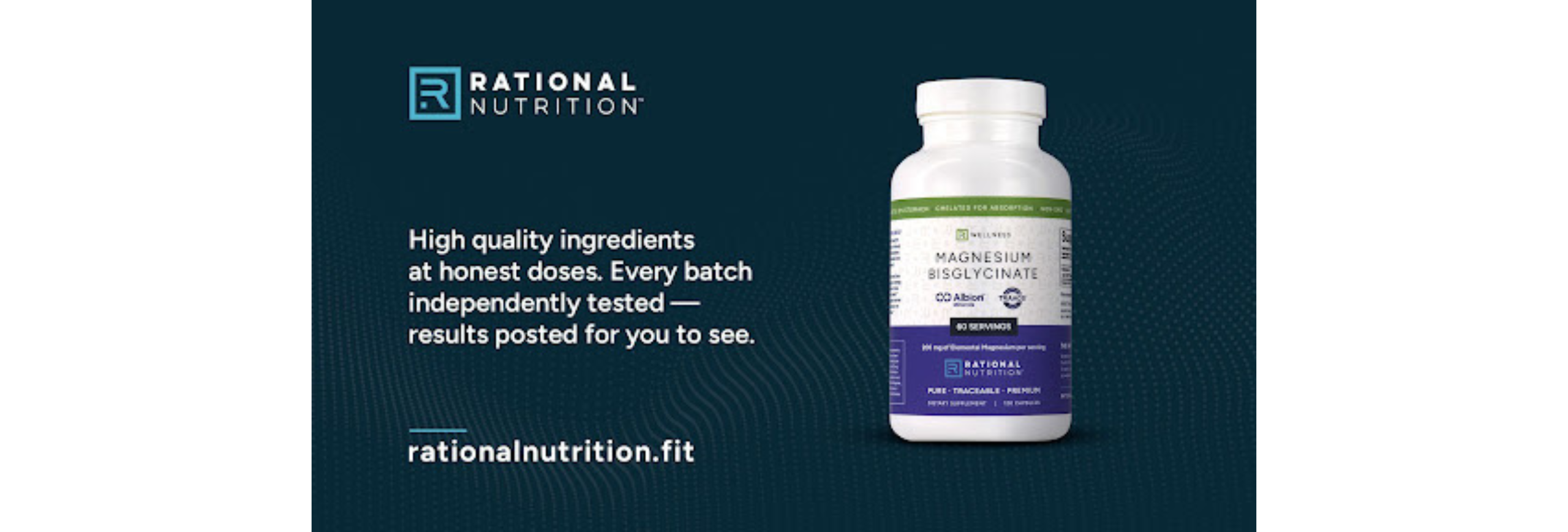
- Magnesium: Albion® TRAACS® magnesium bisglycinate, a chelated form with extensive research behind it. Many competitors use unspecified bisglycinate blends, magnesium oxide (poorly absorbed), or buffered blends that quietly dilute the active form.
These choices — often branded ingredients — are rare because they make the product more expensive to produce. Rational Nutrition’s position is that the sourcing and ingredient form is the product. Using “magnesium” or “fish oil” on a label without specifying the form or its source is the kind of ambiguity that quietly defines the category.
Dosing at Studied Levels, Not Trace Amounts
The other half of formulation is how much of an ingredient actually ends up in a serving. The industry has a long-running practice of including ingredients at fractions of their clinically researched doses — enough to list on the label, not enough to do anything.
Rational Nutrition’s Omega-3 delivers 1,000mg of combined EPA and DHA per serving. Competitors in the same shelf space often deliver materially less — sometimes a third of that — while still marketing themselves as fish oil supplements.
The Magnesium Bisglycinate provides 200mg of elemental magnesium per serving. Others in the category can land as low as 90mg, which you’d only notice if you know how to read a Supplement Facts panel.
The principle is the same across the line: if an ingredient is on the label, it should be there in an amount that means something.
Transparency You Can Actually Verify
Most supplement brands say they test their products. Rational Nutrition publishes the results.
The brand maintains a dedicated lab testing page with detailed third-party testing summaries for every product batch — covering potency, heavy metals, microbial contaminants, and label accuracy, organized by lot number. Testing is primarily conducted by Eurofins, the brand’s main third-party testing laboratory and one of the largest independent food and supplement testing labs in the world. The underlying Certificate of Analysis from the testing lab is available on request for any batch listed.
That kind of product-level transparency is rare in a category where “third-party tested” is often a label claim customers have no way to independently verify.
A Focused Lineup, Not a Catalog
Many supplement companies grow by launching dozens or hundreds of SKUs to cover every category trend. Rational Nutrition has taken the opposite path. Each product has to earn its place by filling a clear gap, improving on a common formulation flaw, or applying a better ingredient form than what’s available at a comparable price. If a product can’t articulate why it exists, it doesn’t get released.
The result is a smaller, more deliberate catalog — designed for customers who’d rather have ten products they can trust than a hundred they have to research individually.
Who Rational Nutrition Is For
Most people who walk into a supplement aisle don’t walk out with anything. The choices are too many, the differences between brands are too opaque, and the homework required to make a confident decision is more than most buyers want to do. Skipping the purchase entirely starts to feel like the safest option.
Rational Nutrition is built first for those buyers — the ones who don’t have time to become supplement experts, and just want to know that the bottle they’re holding is worth what they’re paying. The brand’s pillars exist so the buyer doesn’t have to do the work themselves: the right ingredient forms are already chosen, the doses are already at studied levels, and the testing data is already published for anyone who wants to check.
It’s also built for a second group: customers who’ve been around the category long enough to read supplement facts panels with skepticism, who’ve been burned by underdosed products and proprietary blends, and who’ve started to suspect that most of the price difference between premium and budget supplements is going into marketing rather than the bottle. For those buyers, Rational Nutrition offers something the category doesn’t produce often — a brand whose marketing claims can be checked against the actual product, by lot number, in under a minute.
In an industry that runs on marketing, Rational Nutrition builds the product right — then shows you exactly what’s in the bottle.
Written in partnership with Tom White